
From SaaS to Agents: How AI Is Rewriting the Future of Software
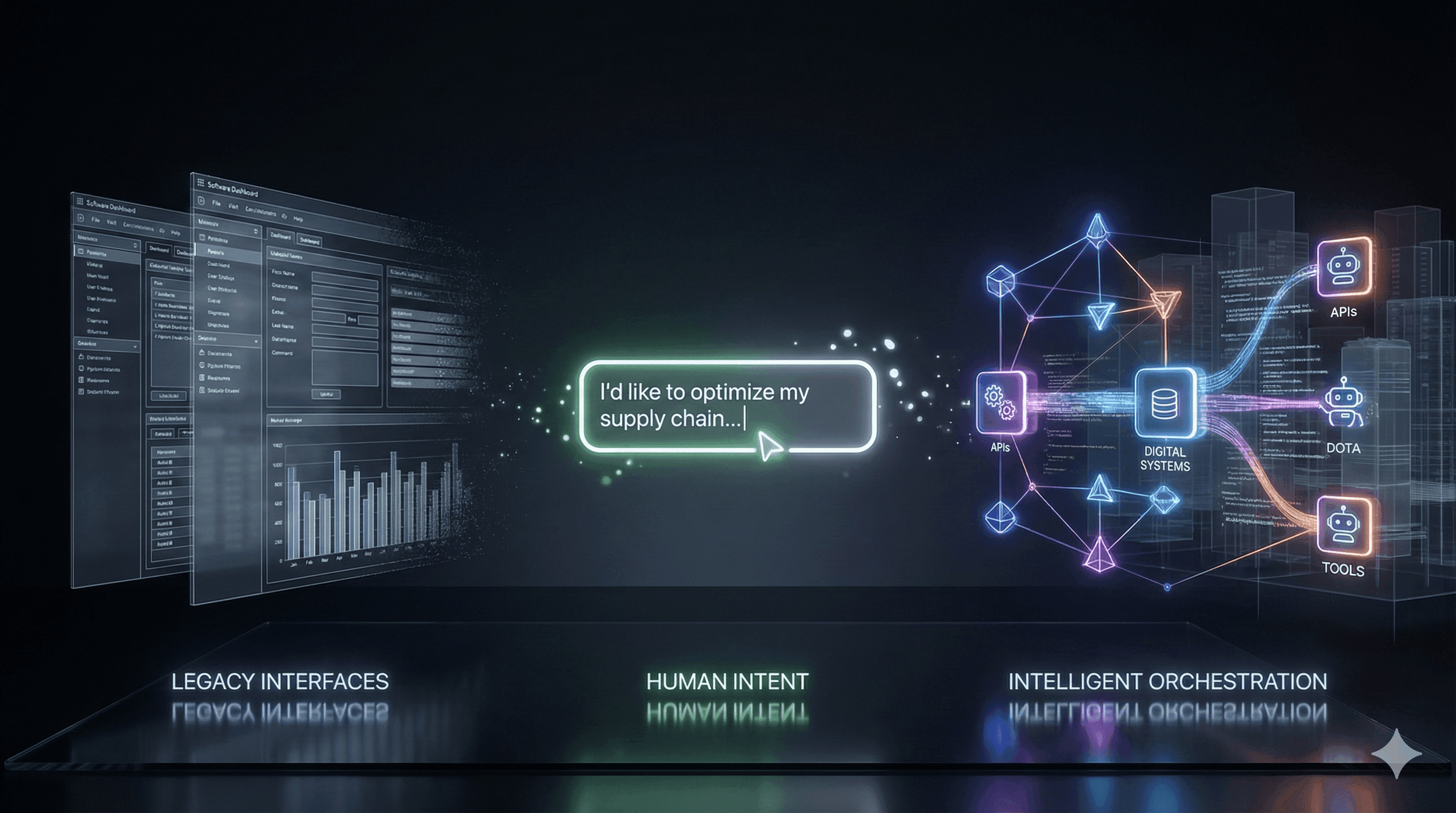
Over the past decade, most software has been built around interfaces — menus, dashboards, forms, and workflows designed for humans to operate step by step. Just six months ago, we were building PrimeForge in exactly this way: a traditional SaaS platform for SMEs, enhanced with AI features running quietly in the background. But the rapid emergence of AI agent frameworks changed the equation. When systems can understand natural language intent and autonomously execute tasks, the role of traditional software interfaces begins to disappear. The AI input box is quickly becoming the primary entry point for software, while agents orchestrate tools and services behind the scenes. PonyBunny was born from this realization. Rather than continuing to evolve a traditional SaaS product, we began building a platform designed for the agent-first era — where software is no longer written primarily for humans to operate, but for AI agents to execute on behalf of users. The goal is simple: make AI-driven task execution reliable enough for real-world business use, especially for small businesses and solo founders who need powerful automation without complex systems.
Why DarkhorseOne Started Building PonyBunny
Six months ago, our focus was very different.
We were building PrimeForge, a traditional SaaS platform designed for small and medium-sized businesses. Like most modern SaaS products, it followed a familiar structure: a web interface, menus, dashboards, and workflows that allowed users to manage their operations.
AI was already part of the system, but in a supporting role.
It lived in the background — helping with automation, analysis, and recommendations.
In other words, the product was still fundamentally human-operated software enhanced by AI.
At the time, that approach made perfect sense.
But the industry changed faster than anyone expected.
The Moment Everything Changed
The emergence of new AI agent frameworks, particularly projects like OpenClaw, revealed something important.
AI was no longer just assisting software.
AI was beginning to replace the way software itself is used.
Instead of navigating complex interfaces and workflows, users could now describe their intent directly in natural language. An AI system could interpret that intent, orchestrate tools, and complete the task automatically.
This change may sound subtle, but its implications are profound.
If AI can understand intent and execute tasks, then many traditional software elements start to lose their purpose.
Menus become unnecessary.
Forms become unnecessary.
Even entire workflows become unnecessary.
The familiar SaaS structure — pages, dashboards, navigation, configuration panels — begins to dissolve.
In the future, the AI input box may become the primary interface of software.
Everything else moves behind the scenes.
Software Is No Longer Written for Humans
This realization forced a fundamental rethink.
For decades, software was designed primarily for human users. Interfaces were carefully crafted so people could navigate systems step by step.
But in an agent-driven world, software is no longer built only for humans.
It is increasingly built for AI agents to operate.
Humans express intent.
AI agents interpret the intent.
Software tools execute the work.
The result is a completely different architecture for digital systems.
Instead of applications designed around user interfaces, the future may consist of systems designed around agent orchestration.
And that realization led directly to PonyBunny.
PonyBunny: A Response to a New Era
PonyBunny did not start as a long-planned product.
In many ways, it was a response to a rapidly changing environment.
As it became clear that agent-based interaction could fundamentally reshape software, it also became clear that existing products — including our own — would eventually need to adapt.
Rather than simply modifying existing SaaS products, we decided to explore a new foundation: a system designed specifically for AI-driven interaction.
PonyBunny is our attempt to build that foundation.
It is designed to enable AI agents to interact with tools, data, and systems in a structured and transparent way, while still maintaining the reliability required for real-world usage.
Where We Are Today
Development began roughly one month ago.
In that short time, PonyBunny has evolved from a concept into a working system capable of orchestrating multi-step AI-driven tasks.
The platform can already coordinate models, tools, and execution flows in a way that demonstrates the core vision behind the project.
However, the system is still early.
While it is functional, there is still work to be done before it can fully support production environments.
Reliability, operational safety, and workflow stability remain critical milestones.
The Next Step
The goal for March is clear.
We aim to move PonyBunny beyond experimentation and into real-world usage.
The next phase will focus on enabling early users to integrate the platform into their daily workflows.
Our initial focus is on small businesses, micro-companies, and solo founders — groups that often face complex operational tasks but lack the resources to manage large software stacks.
If AI agents can successfully handle many of these routine processes, the productivity gains could be significant.
This is where we believe PonyBunny can create meaningful value.
Looking Forward
The shift from traditional software to AI-driven systems will not happen overnight.
But the direction of travel is becoming increasingly clear.
Software interfaces are becoming simpler.
Automation is becoming more intelligent.
And AI agents are beginning to act as the bridge between human intent and digital systems.
PonyBunny is being built with that future in mind.
Not as another application, but as a step toward a new way of building and interacting with software.