
AI Didn't Cause the Layoffs. A Narrow Definition of "Efficiency" Did.
Across industries, AI adoption is increasingly narrated through a single lens: headcount reduction. Having spent the past couple of years advising SME leadership teams on their AI strategies, I think this is a costly category error — efficiency and empowerment are not the same outcome, and most organisations are quietly choosing the wrong one. This article sets out the real distinction between cost-cutting AI and capability-building AI, and why only one of them holds up over time.
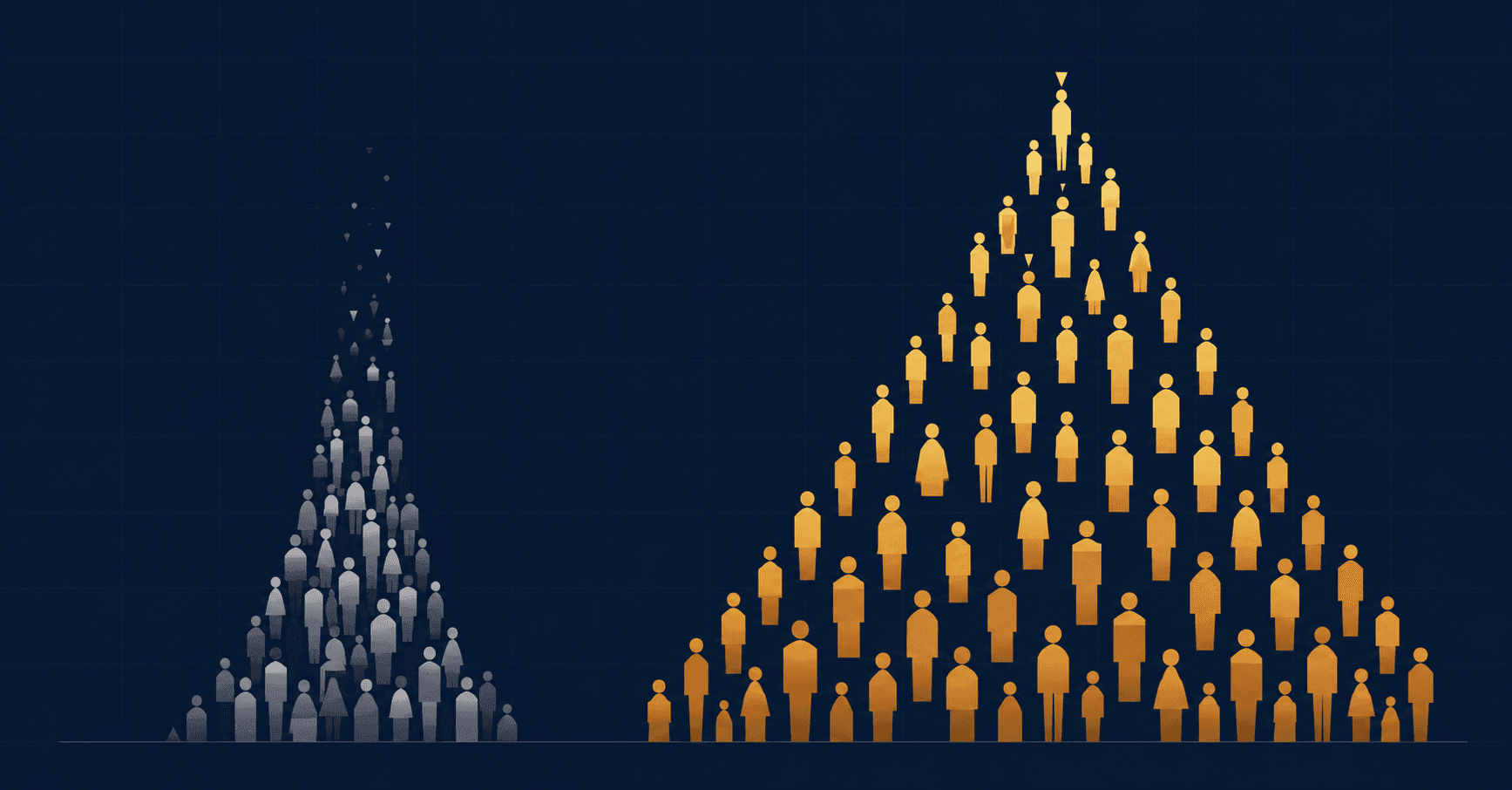
Scarcely a week goes by without a fresh headline: a company announcing redundancies and attributing the savings to artificial intelligence. The story has become so familiar that it's easy to accept its internal logic without examining it — as though AI adoption and headcount reduction were naturally, almost mechanically, linked.
They are not. AI does not decide to cut jobs. Organisations do. And in the vast majority of cases I've observed advising SME leadership teams through their AI roadmaps, the decision being made is not really a decision about technology at all. It is a decision about what "efficiency" is allowed to mean.
That distinction matters more than it might first appear, because it will determine which organisations are still resilient — and which are quietly rebuilding what they cut — several AI cycles from now.
Two Definitions of "Efficiency"
Every organisation adopting AI right now is, whether consciously or not, choosing between two very different operating philosophies.
The first is cost-reduction AI. Its central question is: which roles, tasks or headcount can this technology allow us to remove? It is measured in headcount reduced and payroll saved. It shows up quickly and legibly on a balance sheet, which is precisely why it dominates the current narrative.
The second is capability-building AI — what I'd describe as empowerment-driven efficiency. Its central question is different: what can our existing people now do that they couldn't do before? It is measured not in what has been removed, but in what has been unlocked — faster decision cycles, higher-quality output, capacity redirected toward the work that genuinely requires human judgement.
Both approaches can technically be reported as "AI-driven efficiency gains." That shared label is doing a lot of quiet, misleading work, because operationally and strategically, the two are close to opposites.
Why the Cost-Cutting Path Feels Inevitable
It's worth being honest about why cost-reduction AI is so attractive to leadership teams, because the appeal is real, not irrational.
Headcount is the fastest lever available. Removing a role produces an immediate, quantifiable, board-legible result — a number a CFO can point to in the next set of accounts. Capability gains, by contrast, are diffuse and slower to surface: better client retention, fewer errors, faster turnaround, employees making better calls under pressure. None of that fits neatly into a single line item, at least not in the short term.
There's also a simpler, less comfortable truth. Reducing headcount is easier to plan than redesigning how work gets done. Redeploying reclaimed time toward higher-value work requires leadership judgement about what that higher-value work actually is, genuine reskilling investment, and often a rethink of role design and incentives. Removing a role requires none of that. It is, in a real sense, the path of least organisational effort — which is exactly why it deserves more scrutiny, not less.
The Hidden Cost of Cutting First
In the SME advisory work I do, spanning sectors from professional services to logistics to retail, one pattern shows up often enough that I no longer consider it a coincidence.
Organisations that lead with cost-reduction AI tend to hit a ceiling faster than they expect. They automate a task, remove the team around it, and only later discover that what left the building wasn't just a process — it was judgement, context, client relationships, and the kind of tacit institutional knowledge that never made it into a manual because nobody thought it needed to.
The consequence, more often than leadership teams anticipate, is a rehire — sometimes within a year or two, frequently at a higher cost than the original role, and almost never with the specific experience that was lost fully recovered. The "efficiency gain" reported in one financial year quietly becomes a hiring and onboarding cost in the next, simply moved to a different line and a different conversation.
There's a second, less visible cost too: what cutting-first does to the people who remain. Teams that watch colleagues replaced in the name of "efficiency" rarely respond with more discretionary effort or more trust in leadership's judgement. More often, they respond by protecting themselves — hoarding knowledge, disengaging from ambiguous or exploratory work, and treating every new tool rollout as a threat to be managed rather than a capability to be adopted. That reaction alone can quietly cap how much value AI is ever able to deliver for the organisation going forward.
What Capability-Building AI Actually Looks Like
Empowerment-driven efficiency isn't a softer, slower version of the same destination. It's a different bet entirely: that an organisation's durable advantage sits in its people's judgement, relationships and adaptability, and that AI's job is to protect and expand their capacity for that work, not to compete with it for headcount.
In practice, across the leadership teams I've worked with, this tends to look consistent regardless of sector. AI absorbs the repetitive, low-judgement layer of work — first-draft writing, data reconciliation, routine analysis, administrative processing — and the time that frees up gets deliberately, visibly reinvested. Not left as slack. Reinvested into the work AI still handles poorly: negotiating with a difficult client, making a judgement call on incomplete information, mentoring a junior colleague, spotting a strategic risk that isn't yet in any dataset.
The organisations doing this well tend to share one habit: they treat the "time saved" question as seriously as the "cost saved" question, and they answer it explicitly, function by function, rather than assuming the saved time will sort itself out. Efficiency, in this model, compounds, because capability — unlike a removed headcount — keeps generating value long after the initial investment.
This Is Not an Argument Against Ever Reducing Headcount
It's worth being precise here, because this argument is easy to caricature. Some roles genuinely become redundant. Some organisations are, for entirely legitimate reasons, over-resourced for the work ahead of them. AI adoption is a reasonable moment to have that conversation honestly, and pretending otherwise would be its own form of hype.
The distinction being drawn here isn't "never reduce headcount." It's that headcount reduction should be the conclusion of a genuine capability assessment, not the default objective that AI adoption is judged against from day one. Those are very different starting points, and over time, they produce very different organisations.
The Role HR Has to Play
This is where HR and People functions have a strategic role that's currently underused. In too many organisations, AI adoption is being run as a technology procurement decision or a cost-management exercise, with HR brought in late — mainly to manage the redundancy process once the headcount decision has already been made elsewhere.
That's a missed opportunity, and arguably a risk. HR functions sit on exactly the information leadership needs to make the capability-versus-cost decision well: where institutional knowledge actually lives, which roles carry judgement that was never documented, what reskilling is realistic within a given timeframe, and how a workforce is likely to respond to a given deployment approach. Bringing that expertise into AI strategy at the design stage, rather than the redundancy stage, is one of the more practical ways an organisation can shift from cost-cutting AI to capability-building AI, without slowing its AI adoption down at all.
Questions Worth Asking Before the Next AI Rollout
For leadership teams currently mapping their AI roadmap, a few questions tend to separate the capability-building approach from the cost-cutting one, before a single tool is even purchased:
- Is this initiative scoped as "which roles does this remove," or as "which capacity does this free up, and for what"?
- Has anyone mapped where the tacit, undocumented judgement in this team actually sits — the knowledge that would be hardest to replace if the people holding it left?
- Is HR or People leadership involved at the design stage of this decision, or only once headcount changes need to be actioned?
- If this technology performs exactly as promised in twelve months, what will the remaining team be doing with their reclaimed time — and has anyone actually decided that, or is it being left to chance?
None of these questions rule out difficult headcount decisions where they're genuinely warranted. What they do is make sure those decisions are being made deliberately, as a conclusion, rather than by default.
The Real Question for Leadership Teams
Every one of those questions ultimately points back to the same fork in the road. The organisations still standing several AI cycles from now are unlikely to be the ones that cut deepest, fastest. They are more likely to be the ones that treated their people's capability, not their headcount, as the thing worth optimising for.
That is a strategic choice, not a technological one. And right now, most organisations are still making it by default rather than by design.