
200,000 Stars Later: OpenClaw and the End of “Software for Humans”
By early February 2026, the tool once known as ClawdBot had been renamed twice and finally emerged as OpenClaw. Meanwhile its GitHub repository exploded past 200,000 stars, and suddenly it felt like everyone in the developer world was talking about it. I was one of them. After two weeks of intense, hands-on use, a deeper conclusion became unavoidable: the software industry may be approaching a structural shift. Software is no longer primarily built for humans to operate, but increasingly for AI agents to orchestrate. Complex menus, dashboards, and command memorisation begin to lose relevance when agents can plan and execute workflows themselves. For companies like DarkhorseOne, whose products were originally designed as SaaS tools for human users, this realization forces an urgent strategic decision: adapt immediately—or become obsolete.
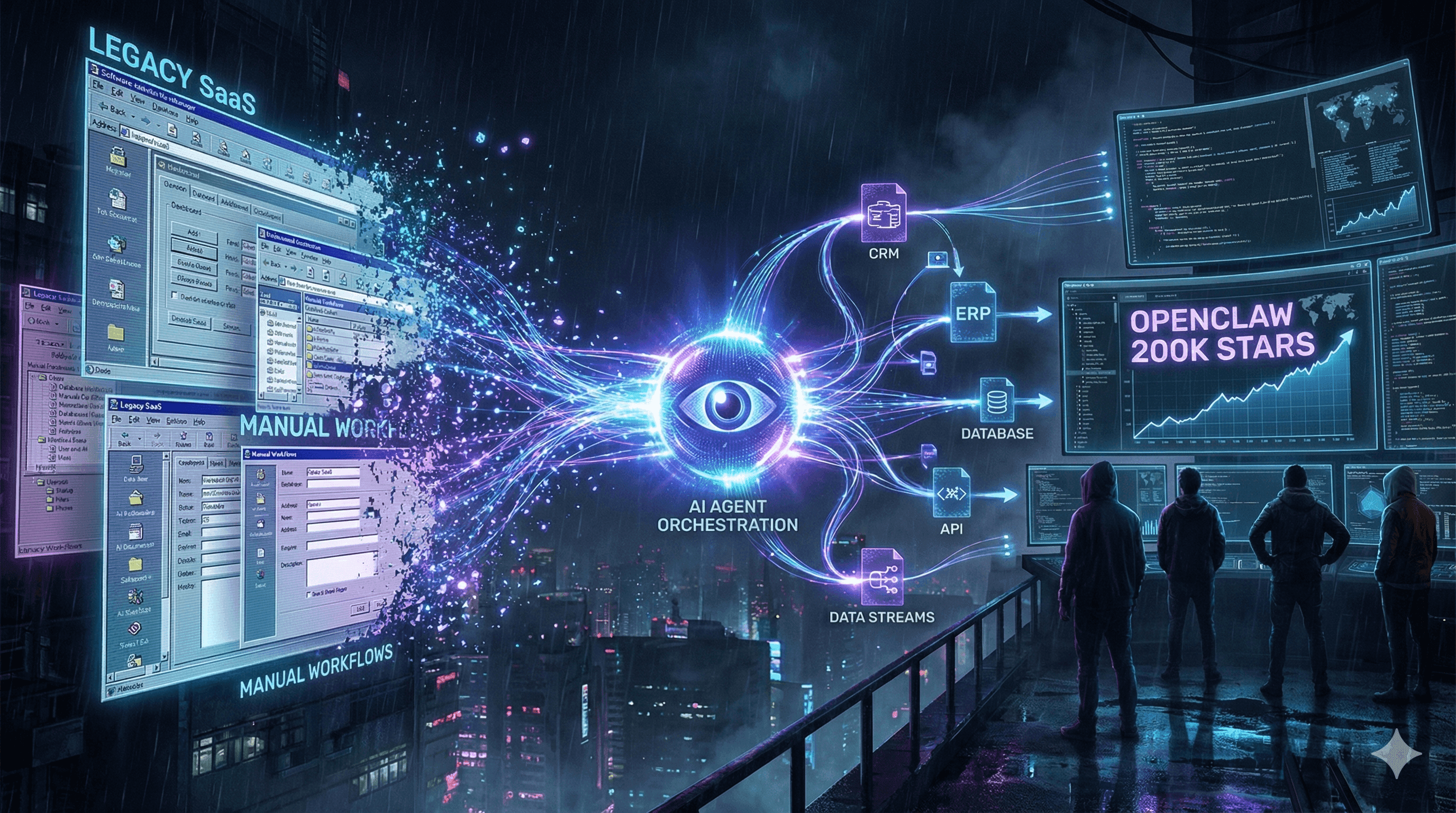
When I first encountered ClawdBot in January, it felt like an interesting experiment.
By early February, it had become something much bigger.
After two rounds of renaming, the project finally settled on the name OpenClaw. At the same time, its GitHub repository experienced a level of growth that I have rarely seen in developer tools. Within weeks, the star count surged past 200,000.
For a period of time it felt like everyone in the developer community was talking about OpenClaw.
And everyone was experimenting with it.
I was no exception.
Two Weeks of Deep Use
Over the next two weeks I used OpenClaw intensively in my daily work.
Not as a toy.
Not as a demo.
But as a real productivity tool.
The experience reinforced something that had already begun to worry me during my first encounter with ClawdBot: this technology fundamentally changes how software is used.
Instead of humans operating software through interfaces, AI agents begin to operate software on behalf of humans.
The difference may sound subtle.
In reality, it is enormous.
The End of Traditional Software Interfaces
For decades, software has been designed around human interaction:
menus
dashboards
configuration panels
command syntax
documentation users must learn and memorise
Even modern SaaS platforms still depend heavily on this structure.
Users must learn how the software works before they can achieve their goals.
But OpenClaw flips this paradigm.
Instead of learning software, the user simply describes the goal.
The AI agent figures out the rest.
Which tools to call.
Which APIs to use.
Which sequence of operations to execute.
The human defines the intent.
The agent handles the implementation.
Software Becomes Infrastructure
This realization led me to a conclusion that felt both obvious and unsettling:
The future of software is not software for humans.
It is software for AI agents.
In this world:
Humans describe goals.
Agents plan actions.
Software exposes capabilities.
The role of software shifts from user interface to machine capability layer.
Menus, forms, and dashboards become optional—or even irrelevant.
What matters instead is whether the software exposes structured capabilities that agents can discover and call.
The Strategic Shock for SaaS Companies
For companies built around traditional SaaS products, this shift is potentially devastating.
SaaS products today compete through:
interface design
user workflows
usability
feature discoverability
But if AI agents become the primary operators of software, then interfaces stop being the competitive advantage.
Agents do not care about beautiful dashboards.
They care about capabilities and access.
For companies like DarkhorseOne, whose products were originally designed as SaaS systems for human users, this realization felt like a strategic shock.
If this future arrives faster than expected, the existing SaaS model becomes dangerously fragile.
The Only Viable Response
Once that conclusion became clear, the response was obvious.
We cannot wait.
We must adapt immediately.
For DarkhorseOne, that means making a decisive shift.
We are now all in on building PonyBunny, an AI-agent-first platform designed for a world where agents orchestrate software.
At the same time, our existing system PrimeForge must evolve.
Instead of being a traditional SaaS interface, its capabilities need to be transformed into something very different.
From UI Software to Agent Capabilities
The strategy is straightforward but radical:
De-interface PrimeForge
Remove dependency on complex user interfaces and menus.
Expose system capabilities
Turn business functions into callable capabilities.
MCP-enable the platform
Allow AI agents to discover and invoke these capabilities dynamically.
In other words, the system must shift from:
to:
PrimeForge stops being a product that people operate.
Instead, it becomes a capability layer that agents orchestrate.
A New Type of Software Company
If this transition succeeds, companies like DarkhorseOne may evolve into something different.
Not SaaS vendors.
But capability providers for AI agents.
Software stops being defined by its interface.
It becomes defined by what agents can do with it.
The Beginning of the Agent Economy
The rapid rise of OpenClaw is not just another developer trend.
It may represent the early phase of an agent-driven software ecosystem.
In such a world:
Agents coordinate tools.
Software exposes capabilities.
Humans define goals.
And the complexity of software disappears behind intelligent orchestration.
Final Thought
Just one month ago, ClawdBot was an obscure experiment.
Today, OpenClaw has hundreds of thousands of developers watching it.
And after two weeks of deep use, one conclusion feels increasingly hard to ignore:
The next generation of software may not be built for humans at all.
It may be built for agents.
And if that future is arriving faster than we expected, the only rational strategy is simple:
Adapt now.
Or risk becoming irrelevant.